

.svg)
If you have started shopping for a garage floor coating, you have probably noticed that "epoxy" is not one single product. Water-based, solvent-based, 100 percent solids, flake systems, polyaspartic topcoats all get lumped together, often at very different price points and with little explanation of which is actually right for your garage. This guide clears that up. You will learn how the main types compare, the real pros and cons of each, and how to match the best garage floor epoxy to how you actually use your space. By the end, you will know which system makes sense for a hard-working New York garage and when it pays to bring in a professional.
There is no single product that wins for every garage. The best epoxy for your garage floor depends on how you use the space, how long you want it to last, the look you want, and your budget. That said, a few technical basics separate a coating that lasts a decade from one that peels within a season.
The most important number to understand is solid content. Solids are the actual material left on your concrete after the coating cures. A water-based product may be roughly 40 to 50 percent solids, which means about half of what goes on the floor evaporates as it dries, leaving a thin film. A 100 percent solids epoxy cures without losing mass, so it builds a much thicker, tougher layer. Higher solids generally means more protection though how the product is applied matters just as much as the number on the can.
It also helps to know that real epoxy is not the same as garage floor paint. Paint air-dries and leaves a thin surface film. Epoxy cures through a chemical reaction between two parts, bonds into the pores of the concrete, and forms a hard, continuous shell. That difference in chemistry is why a proper coating holds up to hot tires, oil, and salt while paint does not.
Most of what you will find falls into three epoxy categories, plus premium topcoats that are often paired with them. Here is how the epoxies themselves stack up.
This is the entry-level option sold in most big-box stores and the easiest for a homeowner to apply. It is low-odor, cleans up with soap and water, and costs the least. The trade-off is film thickness and durability: because much of the product evaporates, you are left with a thin coating that wears faster and is more prone to peeling if the concrete was not prepped well. It can work for a low-traffic garage or a tight budget, but it is not built for heavy daily use.
Solvent-based products also leave a relatively thin film once the carrier evaporates, and they release strong fumes during application that require careful ventilation. They have largely fallen out of favor for residential garages, where safer, higher-performing options are now the norm. Most homeowners can skip this category.
This is the professional standard and, for most homeowners, the core of the best garage floor epoxy coating. Because nothing evaporates, it lays down a thick, high-build layer that bonds deep into the concrete and resists impact, chemicals, and abrasion far better than thinner systems. It is harder to apply correctly, the working time is short and the prep has to be right which is why it is most often installed professionally. When you want a floor that lasts for years rather than seasons, this is the base to look for.
Water-based epoxy is a thin-film coating with around 40–50% solids, making it suitable for budget-friendly, low-traffic garages but less durable over time. Solvent-based epoxy also provides a thin coating but produces strong fumes and offers moderate durability, so it is rarely used in homes today. In comparison, 100% solids epoxy creates a thick, high-build film with high durability, making it the preferred option for daily-use garages and long-term performance.
A quick note on flakes: when a floor gets full decorative flake coverage, a 100 percent solids epoxy is usually the preferred base because it provides the thickness needed to lock everything in.
Once you get past the base coat, the next decision is the topcoat and this is where many of the best garage floor coatings really come together. A growing number of high-end systems pair a 100 percent solids epoxy base with a polyaspartic (a member of the polyurea family) or high-performance polyurethane topcoat.
The reasoning is straightforward. The epoxy base is excellent at bonding into the concrete and building thickness, but a clear epoxy exposed to sunlight tends to shift toward an amber tone over time and scratches more easily. A polyaspartic topcoat stays clear, resists yellowing from UV exposure, and adds strong scratch and chemical resistance, plus a faster return to use. Put together, the two layers give you the best of both worlds: deep adhesion from the epoxy and a tough, good-looking finish from the topcoat.
That combination a 100 percent solids epoxy base, decorative flakes, and a polyaspartic or urethane topcoat is what many installers consider the best epoxy floor coating for garage use in a demanding climate. A single-layer coating can still be a fine choice for lighter use, but the layered system is what delivers the longest life.
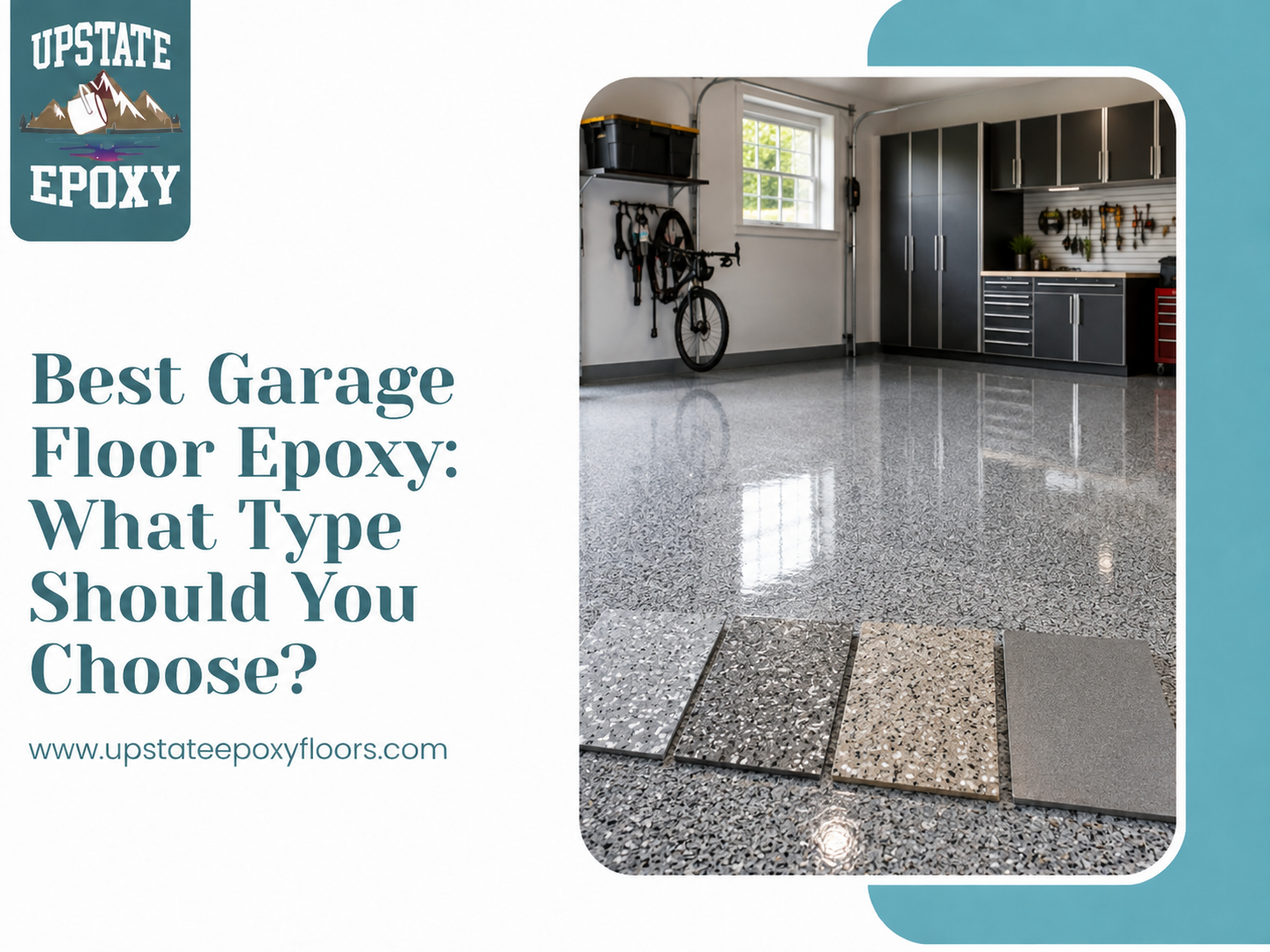
Beyond performance, the finish is where you make the floor your own. Flakes (also called chips) are broadcast into the base coat to add grip, hide minor imperfections, and create texture. You can choose partial coverage for a subtle look or full coverage for a continuous, granite-like surface that conceals the concrete completely. Solid colors are also available if you prefer a cleaner, more uniform appearance. If you are weighing looks, an epoxy color chart is a good place to start narrowing down blends before you request a quote.
With the types clear, matching one to your garage comes down to a few practical questions:
• How do you use the garage? A parking-and-storage garage has lighter needs than a home workshop with dropped tools, chemicals, and rolling loads. Heavier use points toward a 100 percent solids base with a tough topcoat.
• How long do you want it to last? If you would rather not redo the floor in a few years, the thicker, layered systems are the better value over time.
• What look are you after? Full flake coverage hides imperfections and adds grip; solid colors give a sleeker finish. A UV-stable topcoat keeps light colors from ambering.
• What is your budget? Water-based kits cost the least up front; premium epoxy-and-polyaspartic systems cost more but last far longer. Weigh the price against the years of service you expect.
• DIY or professional? The most durable systems are also the hardest to install correctly, which is worth factoring into your decision.
New York winters are hard on garage floors, and that should shape which epoxy you choose. Vehicles pull in wet, dragging snow, slush, and road salt onto the slab. As temperatures rise and fall across the freezing point, that moisture works into the concrete through repeated freeze-and-thaw cycles, and salt is corrosive to bare and poorly sealed concrete alike.
A thin, low-solids coating that is not bonded well is exactly the kind that lets salt and moisture creep underneath and lift the finish. A properly installed 100 percent solids system with a durable topcoat seals the slab, shrugs off the chemicals that drip off a winter car, and cleans up easily when the salt and slush come off your tires. For most New York homeowners, that durability is the deciding factor, not just the color.
Temperature also affects how the coating goes down. Epoxy has to be applied and cured within a specific range, so a good installer controls conditions in the garage rather than coating on a cold day and hoping it sets. That care is part of getting a floor that actually lasts through the seasons.
It is worth being clear about the difference between what you buy off a shelf and what a professional installs. Most consumer DIY kits are thinner, water-based products, and their results depend heavily on how well the concrete is ground and cleaned first a step that is genuinely hard to do well with rented equipment. That is why DIY coatings often last only a few years before they wear or peel.
Professional systems typically use 100 percent solids epoxy, careful diamond-grinding prep, and premium topcoats, and they are built to last far longer. If you want a floor that stands up to New York conditions and looks good for years, professional garage floor epoxy coating is usually the smarter long-term choice. Homeowners refreshing more of the house often pair it with other residential epoxy flooring projects at the same time.
What is the best type of epoxy for a garage floor?
For most homeowners, the best garage floor epoxy is a 100 percent solids epoxy base, ideally paired with a polyaspartic or high-performance polyurethane topcoat and decorative flakes. It builds a thick, durable layer that bonds well and holds up to daily use, while the topcoat adds scratch and UV resistance.
Is 100% solids epoxy really better than water-based?
In terms of durability, yes. Water-based epoxy leaves a thin film because much of it evaporates as it cures, while 100 percent solids cures with no mass loss and forms a much thicker, tougher coating. Water-based can work for light-duty garages, but it will not last as long under heavy use.
Is polyaspartic better than epoxy?
They do different jobs best. Epoxy is excellent as a base coat because it bonds deep into the concrete and builds thickness. Polyaspartic shines as a topcoat, adding UV stability, scratch resistance, and a faster cure. Many top systems use both together rather than choosing one over the other.
Does epoxy yellow over time?
Clear epoxy can shift toward an amber tone with prolonged sun or UV exposure. A polyaspartic or UV-stable topcoat is the usual solution, since it stays clear and protects the color underneath useful for garages with windows or open doors that let in sunlight.
Can I apply the best garage floor epoxy myself?
You can apply a DIY kit, but the highest-performing systems are also the hardest to install correctly because of short working times and demanding prep. Poor surface preparation is the most common reason coatings fail, so for a long-lasting result, professional installation is often worth it.
Which epoxy holds up best to New York winters?
A 100 percent solids epoxy base with a durable topcoat, installed over properly prepped concrete, handles road salt, moisture, and freeze-and-thaw cycles far better than thin, low-solids coatings. Correct installation matters as much as the product itself.
Choosing the best garage floor epoxy comes down to matching the coating to how you use your garage and how long you want it to last. For most homeowners, a 100 percent solids epoxy base paired with a polyaspartic or urethane topcoat and decorative flakes offers the strongest mix of durability, appearance, and value especially in a climate that puts floors through salt, moisture, and freezing temperatures.
If you are a homeowner or business in Upstate Epoxy Floors’ New York service area and want help selecting the right system for your space, reach out for a professional recommendation. A short conversation about how you use your garage is the best way to land on a coating that looks great and holds up for years.