


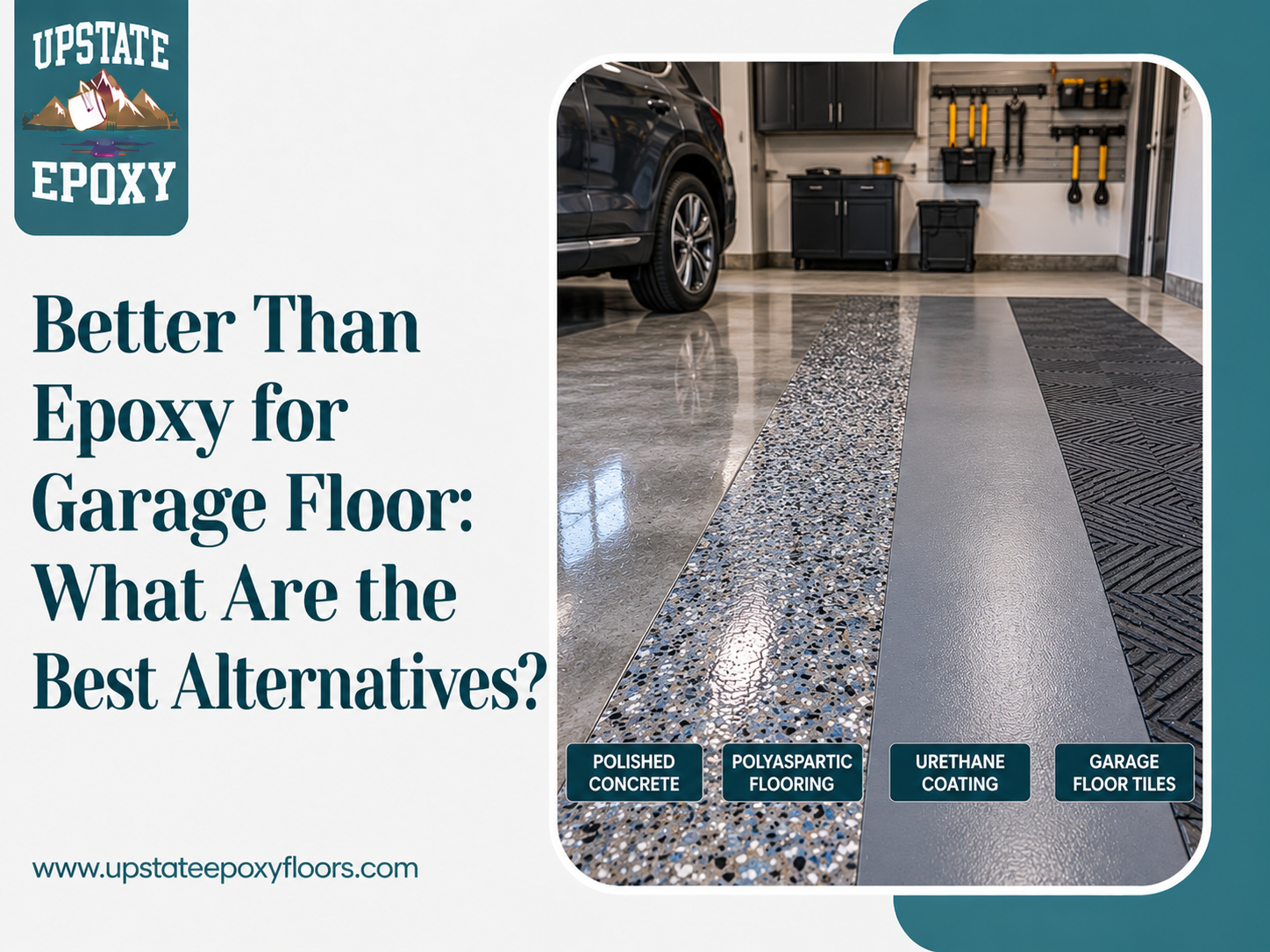
Epoxy has been the go-to garage floor coating for years, and for good reason. But it is not the only option, and for some homeowners it is not even the best one. If you have been searching for something better than epoxy for garage floor use, you likely want a surface that lasts longer, cures faster, resists yellowing, or stands up better to harsh New York winters.
In this article, you will learn what the realistic alternatives to epoxy actually are, how each one performs, and where it makes sense to use them. We will look at polyaspartic and polyurea coatings, resin garage floor systems, acrylic garage floor products, and a few non-coating options. By the end, you will know which surface fits your budget, your climate, and how you actually use your garage.
"Better" depends entirely on what you need the floor to do. Epoxy itself is strong, affordable, and attractive when installed correctly, so any alternative has to beat it in a way that matters to you.
Most homeowners who want something better are trying to solve one of these problems:
Keep these priorities in mind as you read. The right answer for a heated workshop is different from the right answer for a cold storage garage.
If there is one coating most often marketed as being better than epoxy, it is polyaspartic. Polyaspartic and polyurea are closely related resin coatings, and they solve several of epoxy's biggest weaknesses.
Their main advantages:
The trade-off is cost. Polyaspartic materials are more expensive than epoxy, and they cure so quickly that they are genuinely difficult to install well without experience. Many of the strongest garage floors are actually hybrid systems: an epoxy base coat for adhesion and build, topped with a polyaspartic clear coat for durability and UV protection. If you want to compare a full coating system to a single-layer product, our garage epoxy flooring services page explains how multi-coat systems are built.
Polyurethane is another resin-based coating often used as a protective top layer rather than a standalone floor. It is prized for abrasion resistance, chemical resistance, and a tough, slightly flexible finish.
On its own, polyurethane does not bond to bare concrete as well as epoxy, so it is usually applied over an epoxy base. Used that way, it adds scratch resistance and UV protection. As a complete system by itself, it is less common for residential garages than polyaspartic.
The term resin garage floor can be confusing, because epoxy, polyaspartic, polyurethane, and methyl methacrylate (MMA) are all resins. When people ask specifically for a resin floor, they usually mean a seamless, poured resinous system rather than a thin DIY product.
A few points worth understanding:
So a resin floor is not automatically better than epoxy. It is better when the specific resin, the number of coats, and the surface prep are matched to how the garage will be used.
An acrylic garage floor coating sits at the budget-friendly end of the scale. Acrylic sealers and paints are water-based or solvent-based products that are easy to apply, dry quickly, and cost far less than a full resin system.
Where acrylic makes sense:
The limitation is durability. Acrylic coatings are thinner and softer than epoxy or polyaspartic, so they wear faster under hot tires, foot traffic, and dragged tools. For many homeowners, acrylic is a reasonable temporary solution, but it is rarely the answer if you want a floor you can forget about for a decade.
Not every garage floor needs a coating at all.
These options are worth considering if you want something removable, breathable, or closer to a bare-concrete aesthetic.
Climate should drive your decision more than almost anything else, and New York garages take a beating in the colder months.
Here is what each challenge demands of a floor:
For a lot of homeowners in our service area, this is exactly why a polyaspartic or hybrid system edges out standard epoxy. You can see the specific communities we cover on our New York service areas page.
It is tempting to look for a single price, but an honest answer depends on several factors. Rather than quote numbers that may not fit your situation, here is what actually moves the cost:
Cheaper options cost less upfront but often need redoing sooner. A professionally installed resin or polyaspartic floor costs more initially and typically lasts far longer, which usually makes it the better value over time.
Many alternatives are sold as weekend projects, and some genuinely are. Acrylic coatings, interlocking tiles, and roll-out mats are realistic for a confident DIYer.
Poured resin systems are a different story. The failures we see most often come down to a few avoidable mistakes:
The coating is only as good as the surface under it and the hands applying it. If you want a durable, seamless floor and only want to do this once, professional installation is usually the safer investment. Our residential epoxy and coating services walk through how we prepare slabs and build a system that lasts.
Match the surface to how you actually use the space:
When you are ready to compare finishes and colors, the Upstate Epoxy Floors home page is a good starting point to see the systems and design options available.
Is polyaspartic actually better than epoxy for a garage floor? In several ways, yes. Polyaspartic cures faster, resists UV yellowing, and flexes better with the concrete, which helps in cold climates. It costs more, though, and many of the best floors combine an epoxy base with a polyaspartic top coat rather than using one alone.
What is the cheapest alternative to epoxy for a garage floor? An acrylic garage floor coating is usually the least expensive coating option, and interlocking tiles or mats are the most budget-friendly non-coating choice. Both cost less upfront but generally do not last as long as a full resin system.
Is a resin garage floor the same as epoxy? Epoxy is a type of resin, but "resin garage floor" usually refers to a professionally installed, multi-layer poured system that may use epoxy, polyaspartic, polyurethane, or MMA. The right combination depends on how the garage is used.
Which garage floor coating is best for cold New York winters? Flexible, UV-stable systems like polyaspartic and epoxy-polyaspartic hybrids tend to perform best against freeze-thaw movement, road salt, and constant winter moisture. Proper sealing of the slab matters just as much as the coating you choose.
Can I install these alternatives myself? Acrylic coatings, tiles, and mats are reasonable DIY projects. Poured resin and polyaspartic systems are difficult to apply correctly because of fast cure times and demanding surface preparation, so they are usually best left to professionals.
How long does a garage floor coating last? It varies widely by product, prep quality, and use. A thin acrylic coating may last only a few years, while a well-installed resin or polyaspartic system can last much longer. Good concrete preparation is the single biggest factor in how long any coating survives.
Epoxy is a solid choice, but it is not the only one, and sometimes something better than epoxy for garage floor use really does exist for your situation. Polyaspartic and resin systems win on speed, UV resistance, and cold-climate performance, acrylic wins on price, and tiles or sealed concrete suit homeowners who want something removable or more natural. The best option comes down to your budget, your climate, and how hard you use the space.
If you are weighing these alternatives for a garage in New York and want a floor that holds up to our winters, the team at Upstate Epoxy Floors can help you compare systems and find the right fit. Reach out whenever you are ready to explore your options.