


If you have priced out a professional floor and then spotted an epoxy garage floor coating kit at the home improvement store for a fraction of the cost, you have probably wondered whether the kit is good enough. It is a fair question. These kits promise a showroom garage for a weekend's work, and for some homeowners they deliver. For others, they peel within a season.
This article explains what actually comes in a garage floor epoxy kit, how the different types compare, and where DIY kits perform well versus where they fall short. You will learn how to judge whether a kit is worth it for your situation, what separates a good kit from a disappointing one, and when a professionally installed coating is the smarter investment, especially for a New York garage.
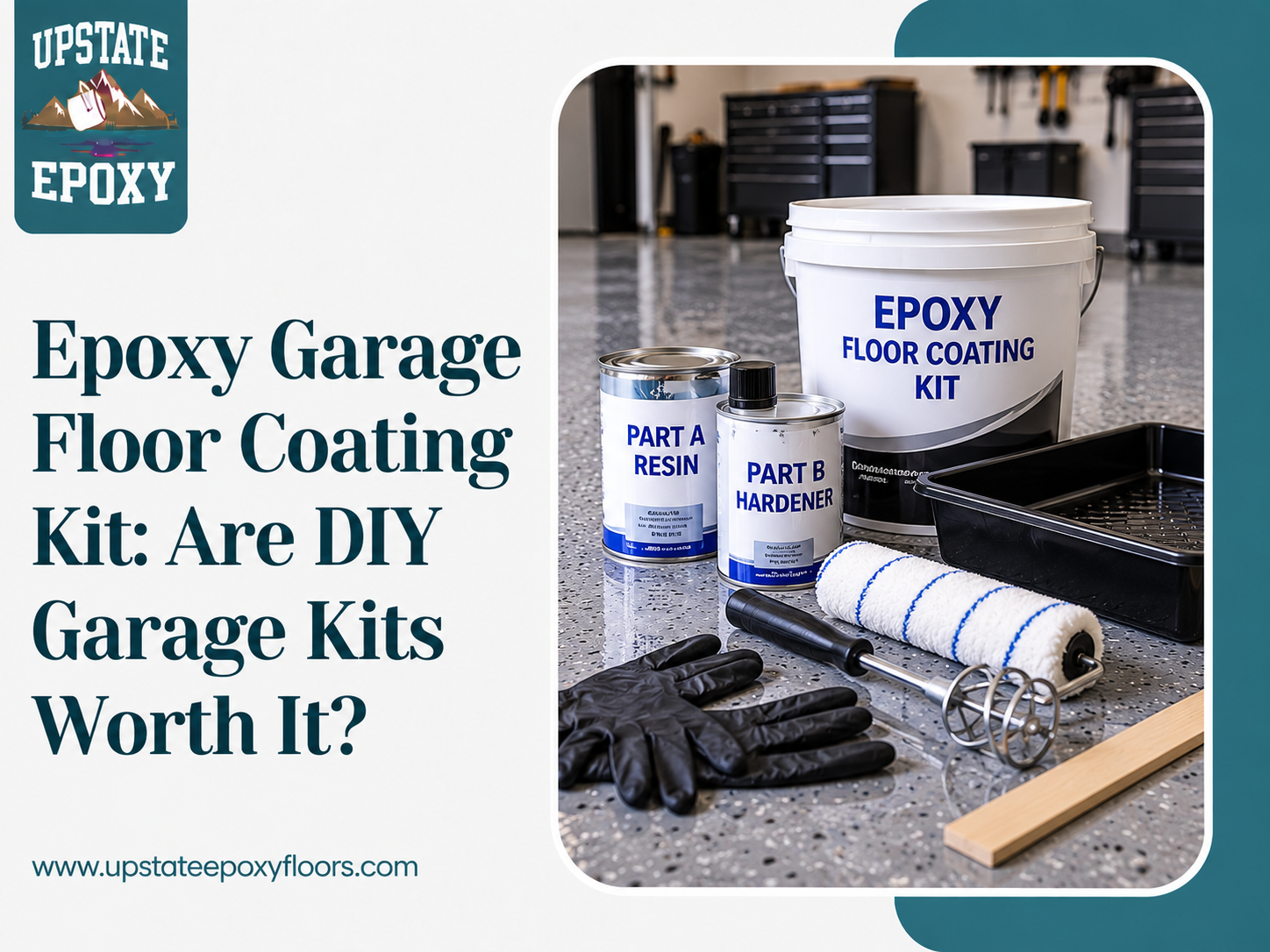
Most consumer kits are designed to coat a specific area and include the core materials in one box. A typical garage floor coating kit contains:
Kits are usually sized by garage capacity, so you will see a 1-car option, a 2-car garage epoxy kit, and sometimes larger sizes. Getting the coverage right matters, because running short partway through a pour is a common and frustrating mistake.
Not all kits are the same, and the type you choose has a big effect on durability. Understanding the categories helps you compare an epoxy garage floor kit to the cheaper products that sit next to it on the shelf.
These are the most beginner-friendly and the easiest to clean up. They go on thin, have a milder odor, and cost less. The trade-off is a thinner film that offers less protection and a shorter lifespan under heavy use.
Solvent-based products build a slightly tougher film than water-based versions. They have stronger fumes during application and require good ventilation, which can be a challenge in a closed winter garage.
These contain little or no filler that evaporates, so they cure into a thicker, more durable layer closer to what professionals use. They are the most demanding to apply because they set faster and are less forgiving of mistakes, and they tend to be the most expensive DIY option.
It is worth separating true epoxy from a basic garage floor paint kit. One-part "epoxy paint" is really a paint with a small amount of epoxy additive. It is inexpensive and simple, but it is far less durable than a genuine two-part system and wears quickly in a working garage.
The honest answer is that it depends on your floor, your expectations, and how much time you can give the job. A DIY epoxy garage floor kit can be worth it when:
A kit is less likely to satisfy you when:
In short, kits reward realistic expectations. Many people are happy with the look right after installation, and the disappointment usually comes later, when inadequate preparation or a thin coating starts to fail.
Here is the point most kit instructions underplay: the coating is only as good as the surface beneath it. The majority of failed DIY floors are not caused by bad epoxy. They are caused by rushed or incomplete preparation.
Professional installers typically use diamond grinding to open up the concrete so the coating bonds mechanically. Most kits instead rely on an acid etch, which is easier but creates a weaker profile. On a smooth, sealed, or contaminated slab, an etch alone often is not enough, and that is where peeling begins.
Two other issues trip up homeowners:
If you take on a kit, budget most of your time for prep rather than for the fun part of rolling on color.
If you decide a kit is right for you, a few factors separate a quality product from a disappointing one. When comparing epoxy floor kits for your garage, look for:
No kit, however, can fully replicate a professional multi-coat system in thickness, surface preparation, or long-term durability. That is the core trade-off to keep in mind.
The appeal of a kit is obvious: lower upfront cost and the satisfaction of doing it yourself. The value question is what the floor costs you over its full life.
A DIY do-it-yourself garage floor epoxy kit saves money today but typically delivers a thinner coating with weaker surface prep, which can mean recoating sooner. A professionally installed floor costs more initially but usually lasts far longer because of proper grinding, moisture management, and higher-grade materials, so the cost per year of service is often lower.
Professional installation makes the most sense when:
If you would rather skip the guesswork, our garage epoxy flooring services page explains how a professional system is built, and our residential epoxy flooring options cover the same quality for other spaces in your home.
Our winters add a layer of difficulty that kit instructions rarely account for.
These conditions are a big reason DIY kits underperform here more often than in milder regions. You can see the areas we serve on our New York service areas page.
Most kit failures come down to a short list of avoidable errors:
Avoiding these dramatically improves your odds of a floor that lasts.
How long does a DIY epoxy garage floor kit last? It varies widely by product type and prep quality. A thin water-based or paint-style kit may last only a few years, while a thicker 100% solids kit applied over well-prepared concrete lasts longer. Professional systems generally outlast any DIY kit.
Is a 2-car garage epoxy kit enough for my garage? Only if the kit's stated coverage matches or exceeds your floor's square footage. Measure your garage and buy a little extra, since coverage estimates assume ideal conditions and running short mid-project causes visible flaws.
Do I need to grind the floor, or is etching enough? Etching can work on clean, bare, porous concrete, but grinding creates a stronger bond and is more reliable on smooth, sealed, or older slabs. Poor surface profiling is the top cause of DIY coating failure.
What is the difference between an epoxy kit and garage floor paint? A true epoxy kit uses a two-part resin and hardener that cure into a hard film. A garage floor paint kit is mostly paint with a little epoxy additive, so it is cheaper but far less durable.
Can I use an epoxy kit in winter? Most kits need warmer temperatures to cure correctly, so an unheated garage in a New York winter is risky. If you want a floor installed during the colder months, professional systems with suitable products are the safer route.
Will a kit hold up to hot tires and heavy use? Thicker, high-solids kits resist hot tire pickup better than thin ones, but no DIY kit matches the durability of a professional multi-coat system under heavy daily use.
An epoxy garage floor coating kit can be a reasonable choice for a clean, newer slab, a cosmetic upgrade, and a homeowner willing to put real effort into preparation. Where kits disappoint is on older or damaged concrete, in demanding use, and in a climate like ours that punishes thin coatings and cold-weather installs. If your main goal is a floor that lasts, the preparation and materials matter more than the price on the box.
If you want to weigh a DIY kit against a professionally installed option, the team at Upstate Epoxy Floors is happy to help homeowners across our New York service area find the right fit. Reach out whenever you would like honest guidance on your garage floor.