

.svg)
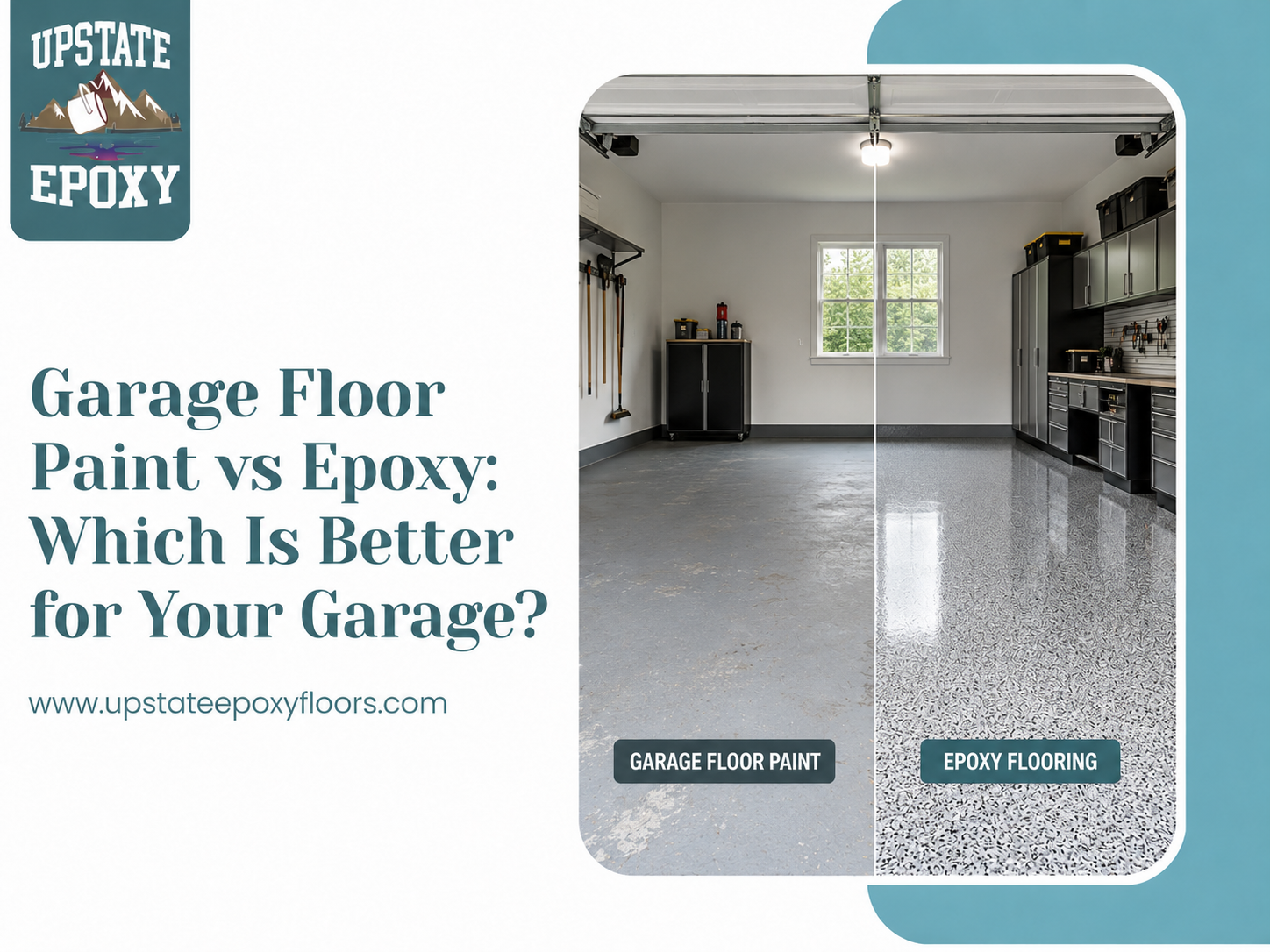
If you're standing in your garage looking at a stained, cracked, or dusty concrete floor, you've probably already searched for garage floor paint options and found two very different products competing for your attention: basic paint and epoxy coatings. They're often marketed together, but they perform very differently over time. This article breaks down how each option works, what they cost, how long they last, and which one makes more sense for a New York garage that deals with snow, road salt, and constant temperature swings. By the end, you'll know exactly which direction fits your garage and your budget.
The terms "garage floor paint" and "epoxy" get used interchangeably online, which causes a lot of confusion. They're not the same product, even though both are applied to concrete to improve its appearance and protect the surface.
Garage floor paint is typically a one-part acrylic or latex paint. It goes on much like the paint you'd use on a wall, forming a thin surface layer that adds color and light protection. Some products marketed as "concrete garage floor paint" or "garage cement paint" fall into this category.
Epoxy garage floor paint, on the other hand, usually refers to a two-part system: a resin and a hardener that chemically react and cure into a hard, plastic-like surface. This is a fundamentally different process than paint drying. Once cured, epoxy forms a much thicker, more durable layer that bonds directly to the concrete rather than simply sitting on top of it.
There's also a middle category worth knowing about: DIY epoxy paint and epoxy kits sold at hardware stores. These blur the line further, since they're technically epoxy chemistry but formulated to be thinner and easier for homeowners to apply than professional-grade systems. Understanding which category a product falls into is the first step to choosing the right one.
Standard garage floor paint is straightforward. After some basic surface cleaning, you roll or brush the paint directly onto the concrete. It dries through evaporation, similar to interior wall paint, and typically doesn't require mixing two components together.
Because it's a thinner coating, garage floor paint is easier for most homeowners to apply as a weekend project. It's also generally the lower-cost option upfront, which is why it appeals to people looking for a quick refresh rather than a long-term flooring solution.
The tradeoff is durability. A painted surface doesn't bond as aggressively to concrete and doesn't build the same thickness as epoxy, so it's more prone to peeling, chipping, and wear in high-traffic areas or where vehicle tires regularly park.
Epoxy paint for garage floors starts with a more involved preparation process, which is a major reason professional results look and perform so differently from a basic paint job. The concrete typically needs to be mechanically profiled, usually through diamond grinding or shot blasting, so the epoxy has a rough enough surface to bond into.
Once the surface is properly prepped, the resin and hardener are mixed and applied. The chemical reaction between the two components is what creates that hard, durable finish, rather than the coating simply drying in open air. Many epoxy garage floor systems also include a broadcast layer of colored flakes or aggregate, followed by a clear topcoat, which adds texture, hides minor imperfections, and improves slip resistance.
This is why professionally installed epoxy garage floor coatings tend to significantly outperform basic garage floor paint in high-traffic residential garages, as well as workshops and commercial spaces.
Garage floor paint has a place, especially for homeowners who want a quick, budget-friendly refresh rather than a long-term flooring upgrade.
Benefits:
Limitations:
Epoxy garage floor paint is generally the stronger long-term investment, particularly for garages that see regular vehicle use, tool storage, or workshop activity.
Benefits:
Limitations:
Pricing for garage floor paint and epoxy paint for garage floors varies based on garage size, the condition of the existing concrete, the number of coats applied, and whether the project is DIY or professionally installed. Basic paint products generally cost less per square foot upfront, while professional epoxy systems involve additional labor for surface preparation, materials for multiple coats, and often a protective topcoat.
Rather than focusing only on the initial price tag, it's worth thinking about cost per year of usable life. A painted floor that needs touch-ups or a full recoat every couple of years may end up costing more over time than a properly installed epoxy system that holds up for many years with minimal maintenance. If you'd like a clearer picture of what a project on your specific garage might involve, Upstate Epoxy Floors' garage epoxy flooring services page outlines what factors go into an estimate.
Whether you choose garage floor paint or an epoxy paint for garage floor application, preparation determines how well the coating performs. Skipping or rushing this step is one of the most common reasons coatings fail early.
Proper preparation generally includes:
Basic paint products often only call for cleaning and light etching, which is part of why they're easier for DIY projects but also part of why they don't bond as strongly. Professional epoxy garage floor paint installations typically involve mechanical grinding, which opens up the concrete's surface at a level a homeowner usually can't achieve with etching solutions alone.
New York garages face conditions that put extra stress on any floor coating. Cold winters mean vehicles regularly track in snow, slush, and road salt. Freeze and thaw cycles can stress concrete itself, and moisture from wet vehicles sitting on the floor for hours at a time adds another layer of wear that garages in milder climates don't deal with as often.
Standard garage floor paint tends to show this wear faster. Salt exposure and repeated moisture can accelerate peeling and staining. Epoxy garage floor paint, especially systems designed with a durable topcoat, generally holds up better against these seasonal stresses because of its stronger bond and greater chemical resistance. This is one of the main reasons epoxy is the more common recommendation for garages in this region, rather than a one-size-fits-all preference.
DIY garage floor paint and DIY epoxy kits are marketed as accessible projects, and for some homeowners with light-use garages, that may be a reasonable choice. However, there's a meaningful difference between a store-bought epoxy paint kit and a professionally installed epoxy coating system.
Professional installation typically involves:
DIY projects are more prone to common mistakes like applying coating over a damp or improperly cleaned surface, skipping crack repairs, or applying the epoxy in temperature and humidity conditions outside the product's tolerance. These mistakes often show up as bubbling, peeling, or uneven color within the first year, which ends up costing more to fix than if the job had been done professionally from the start.
If your garage sees light use, you're working with a limited budget, or you want a quick cosmetic update, garage floor paint can be a reasonable short-term option. But if your garage is used daily, stores vehicles year-round, or deals with New York winters, salt, and moisture, epoxy garage floor paint is generally the better long-term investment. It's more resistant to the wear, chemicals, and temperature swings that break down basic paint faster.
For homeowners who want the durability of epoxy without the risk of a DIY project going wrong, professional installation is worth considering. You can learn more about how the process works and what's included through Upstate Epoxy Floors' residential epoxy flooring services.
Is epoxy the same as garage floor paint? No. Garage floor paint is typically a one-part acrylic or latex coating, while epoxy is a two-part system that chemically cures into a much harder, thicker surface.
How long does garage floor paint last compared to epoxy? Basic paint generally wears faster and may need recoating within a few years, especially in high-traffic garages. Properly installed epoxy typically lasts significantly longer due to its stronger bond and thicker application.
Can I paint over epoxy garage floor paint? It depends on the condition of the existing coating and how it was prepared. In many cases, the old coating needs to be properly cleaned, profiled, or partially removed before a new coating will bond well.
Do I need to prep my garage floor before painting? Yes. Skipping preparation, such as cleaning, degreasing, and repairing cracks, is one of the most common reasons both paint and epoxy coatings fail early.
Is DIY epoxy paint for garage floors worth it? DIY epoxy kits can work for light-use garages, but they generally don't match the durability of professionally installed systems, which use stronger formulations and proper mechanical surface preparation.
Does garage floor paint hold up to New York winters? It can, but road salt, moisture, and freeze-thaw cycles tend to wear down basic paint faster than a properly installed epoxy coating.
Both garage floor paint and epoxy can improve the look of a concrete garage floor, but they're built for different needs. Paint offers a lower-cost, simpler option for light use, while epoxy garage floor paint delivers stronger durability and better resistance to the conditions New York garages face throughout the year. If you're weighing garage floor paint against a professionally installed epoxy system, it often comes down to how heavily your garage is used and how long you want the results to last. If you're in Upstate Epoxy Floors' New York service area and want help deciding what's right for your garage, reaching out for a professional assessment is a straightforward next step.