

.svg)
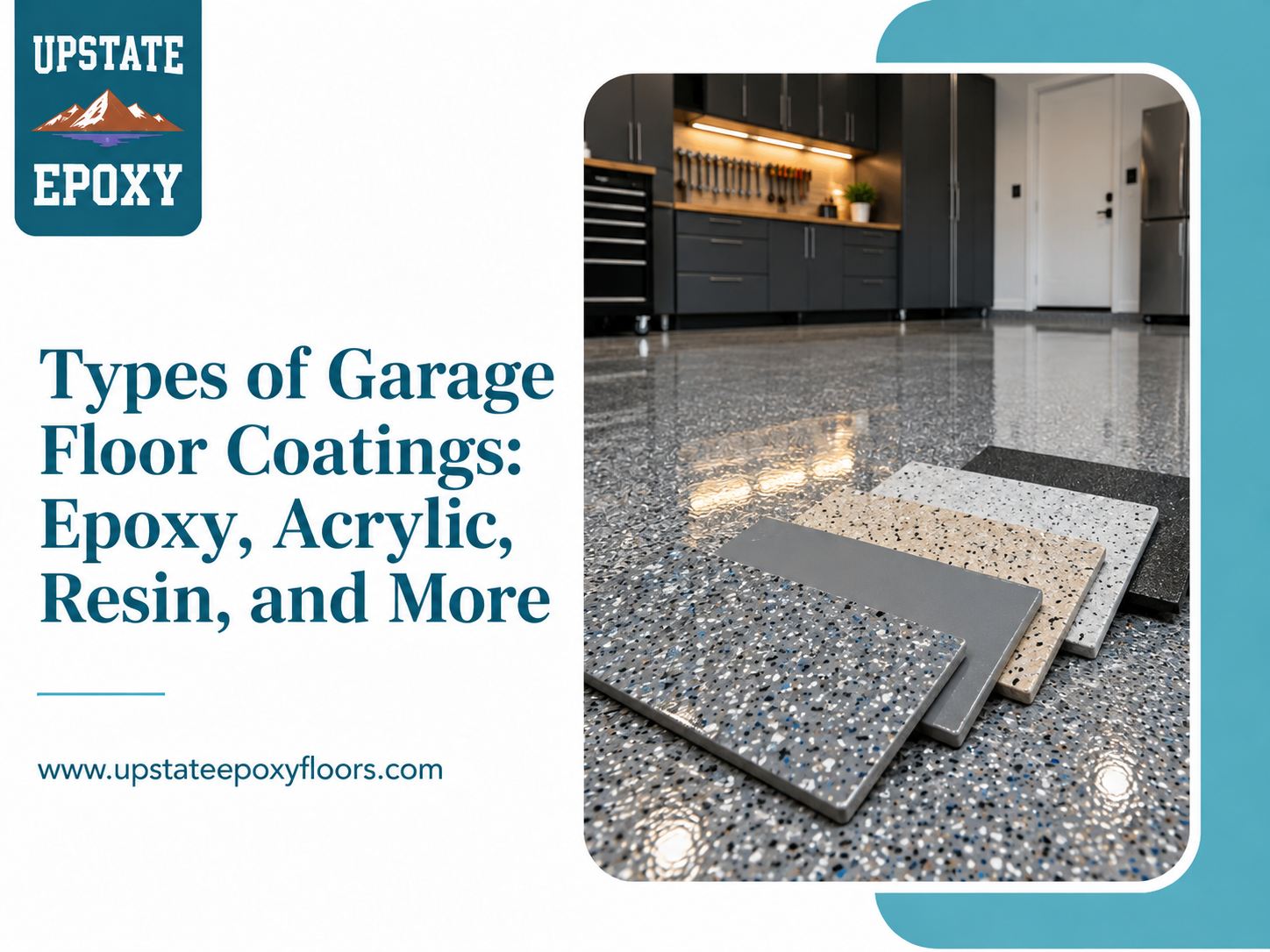
If you've started researching garage floor coatings, you've probably run into a wall of overlapping terms: epoxy, polyaspartic, polyurea, acrylic, resin, flake, metallic, tiles, mats. It's hard to tell what's actually different and what's just marketing. This guide sorts out the main types of garage floor coatings, explains how each one works in plain language, and shows where each performs best and where it falls short. You'll learn the difference between liquid-applied coatings and non-coating coverings, how the popular "resin" systems relate to one another, and which options stand up to New York's salt and freeze-thaw winters. The goal is simple: by the end, you'll understand your choices well enough to pick a finish with confidence instead of guessing from a product label.
It's easier to compare options once you group them. Garage floor finishes fall into two broad categories:
There's one more distinction worth knowing: within liquid systems, some products are used as the base coat that builds thickness and bonds to concrete, while others work best as the topcoat that adds protection and resistance to wear. Many of the best garage floor solutions actually combine two chemistries, which is why you'll often see "epoxy with a polyaspartic topcoat" rather than a single product. Keep that layering idea in mind as we go through each type.
These are the coatings that chemically cure and bond to a prepared slab. They differ mainly in durability, cure speed, UV stability, and cost.
Epoxy is the best-known coating for garage floor applications and a strong all-around performer. It's a two-part resin that cures into a hard, thick film with excellent resistance to impact, abrasion, oil, and chemicals. It bonds well to properly prepared concrete and comes in a wide range of colors.
Its main limitations are a longer cure time and sensitivity to UV light, which can cause some epoxies to yellow where sunlight hits them. That's why quality installations usually seal epoxy under a more UV-stable topcoat rather than leaving it exposed.
Polyaspartic is a fast-curing, highly durable coating most often used as a protective topcoat. It resists UV yellowing, handles temperature swings well, and cures quickly enough that some systems allow light use the same day. Paired over an epoxy or flake base, it's one of the most resilient finishes available for a garage.
The trade-off is a shorter working time during application and a higher cost, both of which favor experienced installers.
Polyurea is closely related to polyaspartic and shares many of its strengths: fast curing, strong flexibility, and good resistance to abrasion and chemicals. Its flexibility helps it tolerate the small movements and temperature changes a slab goes through, which matters in a climate with real winters. Like polyaspartic, it's commonly used as a base or topcoat within a layered system.
Polyurethane coatings are prized for abrasion resistance, chemical resistance, and UV stability. They tend to be thinner than epoxy and are frequently used as a clear topcoat to protect a decorative layer and add gloss. On their own they don't build the thickness epoxy does, so they're usually part of a system rather than a standalone floor.
Acrylic coatings and sealers sit at the budget, easier-to-apply end. They're typically water-based, breathable, and quick to dry, and they're often used to seal or lightly refresh decorative concrete. For a hard-working garage, though, acrylics are thinner and less durable than the resin systems above, wearing faster under hot tires and heavy traffic. They can be a reasonable short-term or low-traffic choice but rarely match epoxy or polyaspartic for longevity.
"Resin flooring" is an umbrella term, not a separate product. Epoxy, polyaspartic, polyurea, and polyurethane are all resin-based coatings. So when you see a garage floor described as a "resin coating," it's almost always one of these chemistries or a combination of them. Knowing that keeps you from comparing "resin" against "epoxy" as if they were two different things.
The chemistries above are also the building blocks for the finishes most homeowners picture:
These are really combinations of the coating types rather than separate materials. If you want to go deeper on choosing between them, the professional garage epoxy flooring page and the project gallery show how each system looks installed, and the epoxy color chart covers the color side of the decision.
Not every garage floor covering is a coating. These options go over the slab without bonding to it, which makes them easier to install but generally less protective.
These coverings suit renters, quick projects, or spaces where a permanent bonded finish isn't the goal. For a long-term, seamless, moisture-sealing result, a liquid coating still has the edge.
No single type wins on every measure, so it helps to weigh them against what matters to you.
On price, it's more useful to understand the drivers than to chase a figure. Cost depends on the system, the floor size, the condition of the concrete, and how much preparation the slab needs. Color choice has little effect on price; system type has the most.
New York garages deal with snow, slush, road salt, humidity, and freeze-thaw cycles that stress both the slab and whatever covers it. A few points help narrow the field for local homeowners:
None of this rules out tiles or mats; it just explains why bonded coatings with durable topcoats are the common recommendation for a four-season New York garage.
Several of these options are genuinely DIY-friendly. Roll-out mats and interlocking tiles need no special skill, and acrylic sealers and basic epoxy kits are sold for homeowners. The catch with liquid coatings is that results depend heavily on surface preparation and application technique.
DIY kits typically use thinner coatings and rely on acid etching instead of mechanical grinding, which can compromise the bond. Fast-curing products like polyaspartic leave little room for error. Professional installation brings commercial-grade materials, proper grinding and moisture handling, and the experience to layer systems correctly. The same expertise carries over to interior spaces, so if you're weighing coatings beyond the garage, residential epoxy flooring uses the same material logic for basements, laundry rooms, and home gyms.
What are the main types of garage floor coatings? The core liquid-applied types are epoxy, polyaspartic, polyurea, polyurethane, and acrylic. These are often combined into decorative flake, metallic, or quartz systems. Beyond coatings, non-bonded coverings like interlocking tiles and roll-out mats are also used on garage floors.
Is epoxy or polyaspartic better? They're frequently used together rather than being direct competitors. Epoxy builds a strong, thick bonded base, while polyaspartic adds a fast-curing, UV-stable, highly durable topcoat. A combined system captures the strengths of both.
What's the difference between resin and epoxy garage floors? "Resin" is a general term for the whole family of resin-based coatings, which includes epoxy, polyaspartic, polyurea, and polyurethane. Epoxy is one specific type of resin coating, so they aren't two separate categories.
Are garage floor tiles or mats as good as a coating? They're easier and faster to install and can be removed, which suits renters or temporary setups. But they don't bond to the slab, can collect grit at seams or trap moisture underneath, and don't provide the seamless, sealed protection of a liquid coating.
Which garage floor coating lasts the longest? Professionally installed epoxy systems finished with a polyaspartic or polyurea topcoat generally last the longest, especially with proper surface preparation. Thin acrylics, DIY paints, and non-bonded coverings have shorter lifespans under regular vehicle traffic.
Do I need a different coating type for a cold climate? Cold climates favor coatings with good flexibility and UV stability, which is why polyaspartic and polyurea topcoats are popular in New York. They tolerate temperature swings and resist the salt and moisture that come with winter better than acrylic or bare epoxy.
Understanding the types of garage floor coatings makes the whole decision less overwhelming. Epoxy, polyaspartic, polyurea, polyurethane, and acrylic are the main liquid chemistries, often layered into flake, metallic, or quartz systems, while tiles and mats offer simpler non-bonded alternatives. For a long-lasting, seamless finish that holds up to New York winters, a professionally installed coating with a durable topcoat is usually the strongest choice, but the right type ultimately depends on your garage, your budget, and how the space is used.
If you're in Upstate Epoxy Floors' New York service area and want help matching the right coating type to your floor, request a free estimate for a recommendation built around your concrete and your climate.